How to Reduce Visual Clutter in a Small Apartment
When a tidy apartment still looks busy, the cause is visual: too many colors, small objects, cords, mismatched containers and competing patterns. Diagnose six common problems, fix each one and keep it that way with a ten-minute weekly reset.
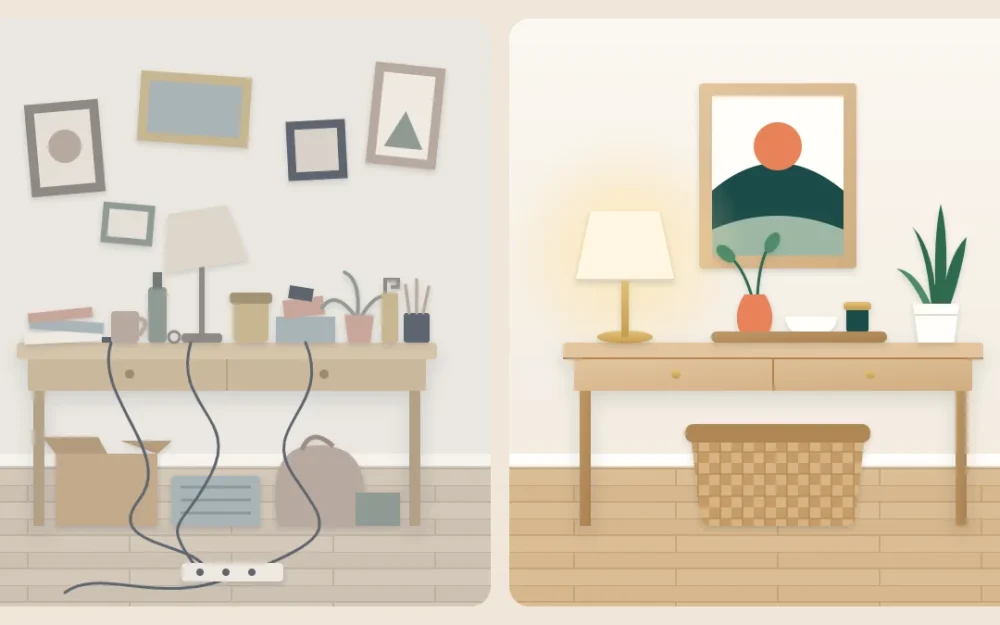
You have put everything away, wiped the counters and folded the throw, and the room still feels busy. That restless, tiring quality has a name: visual clutter. It is not mess. It is too many separate things asking for your attention at once.
In a small apartment it shows up fast, because every surface is within a few steps of your eyes and several rooms’ worth of belongings share one view. The encouraging part is that this is a decorating problem with decorating fixes. Very little needs to be thrown out; mostly things need to be grouped, quieted or moved out of sight.
First, find where the noise is
Stand in the doorway, or sit in your usual seat, and half-close your eyes. Details blur, and what remains is a pattern of shapes and colors. Calm areas merge into a few large blocks. Cluttered areas stay speckled, like static.
Note the two or three speckled spots. They are nearly always the same places: the coffee table, the console by the door, open shelves, the top of a dresser and the corner where the electronics live. Then match each spot to one of the six problems below.
Problem: too many colors in one view
What you see: a red book spine, a blue mug, a yellow cushion, a green box and an orange throw, none related to the others. Each color is one more thing for the eye to process.
The fix: limit the palette. Choose a light base, one or two neutrals and one or two accent colors, then walk around the room removing whatever falls outside them. You do not have to give these things up. A bright mug goes inside a cupboard, an off-palette cushion gets a new cover, and loud packaging is decanted or turned to face the wall.
Problem: a scatter of small objects
What you see: a surface dotted with little things, each sitting alone: a remote, lip balm, three coasters, a pen, a small figurine, a pair of glasses.
The fix: start by clearing one surface completely. Leave it bare for a day so you can see what calm looks like there. Then put back only what the surface needs, and group the small pieces on a tray so that several objects read as one. As a loose guide, a surface with one large item, one group and some empty space looks settled. For what to hold everything in, these baskets, boxes and trays that double as decor are a good place to begin.
Tip
Swap many small decorative objects for one larger one. A single big vase or bowl gives the same personality with a fraction of the visual noise.
Problem: cords on show
What you see: dark lines trailing down a pale wall, a knot of chargers on the floor, a power strip in plain view beside the sofa.
The fix: shorten, gather and hide. Coil any extra length and hold it with a reusable tie. Run cords down the back of a furniture leg or along the back edge of a console instead of across open wall. A cord box or a lidded basket with a gap at the back hides a power strip and its plugs; leave space around the plugs and avoid packing anything on top of them. Keep one charging spot, in a drawer or a box, so chargers are not spread across three rooms.
Problem: open storage with noisy contents
What you see: open shelves full of mismatched packaging, paperwork, toiletries or toys, often in containers that do not match each other either.
The fix: keep open storage for things that look good, and give the rest a door or a lid.
- Move noisy contents into closed cabinets, drawers or lidded boxes.
- Replace mismatched containers with two or three types that repeat across the room.
- Calm a bookcase by grouping books by color, or by turning the loudest spines to face inward so the paper edges show. Do this only for books you rarely look up by title.
- Leave part of every shelf empty so each group has an edge.
Problem: patterns competing
What you see: a patterned rug, a patterned sofa throw, patterned cushions, patterned curtains and a busy artwork, all at a similar scale. No single one is wrong; together they flicker.
The fix: let one pattern lead and make the others support it. Keep the boldest pattern on one large surface, usually the rug or the curtains. Add at most one or two smaller patterns in the same colors at a clearly different scale, such as a fine stripe beside a large floral. Make everything else plain, and rely on texture, such as linen, wool and wood, for interest.
Problem: nowhere for the eye to rest
What you see: something on every wall and every ledge. Each piece may be lovely, but there is no pause between them.
The fix: choose one wall, or one generous stretch of wall, and leave it empty on purpose. The wall you face from the bed or the sofa is a good candidate. Blank space is not unfinished; it is what lets the decorated walls stand out. If you find you prefer the room this way, a more pared-back style may suit you, and this guide to a calm, edited look that still feels warm takes the idea further.
A ten-minute weekly reset
Visual clutter creeps back, because daily life keeps setting things down. A short reset once a week holds the line. Set a timer and work in this order:
- Walk through with a basket and collect anything that has drifted from its home.
- Clear the main surfaces: coffee table, console, dresser top. Return only the lamp, the tray and one other item.
- Straighten what is left: square up book stacks, fold the throw, plump and line up cushions.
- Tuck cords back behind furniture and put chargers back in their one spot.
- Do the half-closed-eyes check from the doorway and fix the one spot that still looks speckled.
If the room is calm after all this and still looks slightly off, the cause is probably not clutter but scale or placement, such as a rug that is too small or art hung too high. This list of common decorating problems and easy fixes will help you identify which one.
Frequently asked questions
What is the difference between clutter and visual clutter?
Clutter is things out of place: mail on the chair, shoes in the hall. Visual clutter can exist when everything is put away, because it comes from how much the eye has to take in. Many colors, small separate objects, visible cords and busy patterns all create it, even in a perfectly tidy room.
Where should I start if the whole apartment looks busy?
Pick the one surface you look at most, often the coffee table or the console by the door, and clear it completely. Put back a lamp or one large object and a tray with a few items. Seeing a single calm surface makes the next noisy spot obvious, and you can move through the room one area at a time.
Does open shelving always look cluttered in a small room?
No, but it needs editing. Open shelves look calm when they hold things with similar colors, some larger objects and visible empty space. Put packaging, paperwork and small loose items in lidded boxes or behind doors, and keep the open shelves for books and a few pieces you enjoy seeing.