Minimalist Small Apartment Decor: A Calm, Edited Look That Still Feels Warm
Minimal decor is editing, not emptiness. Learn the five principles behind a pared-back apartment that stays warm, from fewer and larger pieces to natural materials and negative space, then follow a step-by-step edit of one room.
The appeal of a pared-back home is obvious when you live in few square feet: less to look at, less to dust, more room to breathe. The worry is just as common. Take too much away and the place can feel like a waiting room, all white walls and echo.
A minimalist small apartment does not have to be cold or empty. The version that works is an edited one: fewer things, each chosen with more care, in materials that are pleasant to see and touch. Warmth comes from what you keep, not from how much of it there is.
Minimal is editing, not emptiness
Decluttering and minimal decorating overlap, but they are different jobs. Decluttering asks “do I need this?” and ends when the excess is gone. Minimal decorating asks “what should this room look like?” and treats every remaining piece, and every gap between pieces, as a design decision.
That is why a room can be thoroughly decluttered and still not look minimal. Ten small, unrelated objects spread evenly around a tidy room are still ten things competing. If busyness is the main complaint and a spare look is not really your goal, the guide to reducing visual clutter may be all you need. If you want the calmer, more deliberate look, the five principles below build it.
Choose fewer, larger pieces
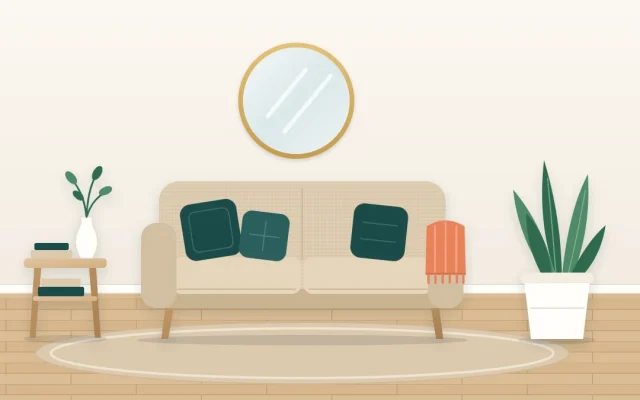
It sounds backward for a small room, but a few generous pieces look calmer than many small ones. One sofa and one good armchair instead of a loveseat, two stools and a pouf. One large artwork instead of a scatter of little frames. One substantial lamp instead of three tiny ones.
Larger pieces give the eye a few clear shapes to read. They also tell the room what matters. A single strong feature, with quiet surroundings, is easier to live with than a room where everything is equally important; there is a full method for choosing one in the guide to creating a focal point in a small living room.
Keep a tight palette of warm neutrals
Cold minimal rooms usually share one trait: stark white paired with gray and black. Shift the same restraint toward warmth and the mood changes. Think warm white, oatmeal, sand, soft clay, mushroom and the honey tones of wood, with one muted accent at most, such as olive, rust or ink blue.
Three or four closely related tones are enough. Because the colors sit near each other, the room stays quiet even when the shapes vary. If you are unsure which neutrals lean warm or how to read the floor and fixed surfaces you already have, the steps for choosing a color palette walk through it.
Let natural materials do the warming
When color is restrained, texture carries the room. This is the part that separates a warm minimal home from an empty one. Aim for a small set of natural materials and repeat each of them:
- Wood: a side table, a stool, a frame, a bowl. Visible grain is decoration in itself.
- Linen and cotton: slightly rumpled curtains, cushion covers and bedding soften hard lines.
- Wool: a throw or a rug with some pile adds depth underfoot and on the sofa.
- Ceramic and stone: a matte vase, a hand-shaped bowl, a lamp base with an uneven glaze.
Light matters as much as material. A couple of plug-in lamps with warm bulbs and fabric shades, switched on in the evening instead of a single overhead light, keep pale surfaces from looking flat.
Tip
If the room feels chilly, add a texture before you add an object. A wool throw over the sofa arm warms a space more than three new ornaments.
Treat empty space as part of the design
In a minimal room, the bare stretch of wall, the clear floor beside the sofa and the open half of a shelf are doing work. Negative space frames what is there, the way a wide mat frames a small print. It is also what helps a compact room feel open.
The hard part is leaving it alone. An empty corner invites a plant stand; a blank wall invites a shelf. Before filling a gap, ask whether the room looks unfinished or simply quiet. Often it is the second, and the urge passes within a week.
One considered object per surface
As a rule of thumb, give each surface one thing to say. A side table holds a lamp. A console holds a vase with a single branch. A coffee table holds one tray or one stack of books, not both. The object can be large and interesting; it simply has no rivals.
Everyday items still exist, of course. Remotes, chargers, mail and keys go behind doors, in drawers or in a lidded box, with one fixed spot for each. Hidden, easy-to-reach storage is what lets the surfaces stay that clear from day to day.
How to edit one room, step by step
Take one room and give it an unhurried hour or two. Starting with the living area makes sense, since it is seen most.
- Remove everything small. Take all accessories, cushions, throws and loose objects out of the room. Leave only furniture, lamps and the rug.
- Look at the furniture. Is there a piece that never gets used, or two small pieces doing the job of one? Try the room without it for a week before deciding.
- Check the palette. Note anything large that fights the warm neutrals, and consider a cover, a throw or a new position for it.
- Bring back texture first. Return the throw, two or three cushions and anything in wood, wool or ceramic that you love.
- Add objects one at a time. One per surface. After each addition, step back to the doorway. Stop when the room feels warm, which is usually sooner than expected.
- Rehome the remainder. Whatever did not come back goes into closed storage, a different room or out of the apartment.
- Live with it. Give the room a week. If a spot still feels bare after that, add one thing there and no more.
Then repeat in the bedroom, where the same approach, with a little more softness in the bedding, tends to feel restful almost at once.
Frequently asked questions
How do I keep a minimalist apartment from feeling cold?
Swap stark white and gray for warm neutrals, and lean on texture: wood, linen, wool and matte ceramic. Use two or three lamps with warm bulbs in the evening instead of one overhead light. A room with few objects but plenty of soft, natural surfaces reads as calm, not bare.
Is minimalist decor the same as decluttering?
No. Decluttering removes what you do not need, and it can leave a room that is tidy but still visually busy. Minimalist decor goes a step further and designs what remains: fewer and larger pieces, a narrow palette, deliberate empty space and a single object on each surface.
Can I have plants, art and books in a minimalist room?
Yes. Minimal means edited, not empty. Choose one larger plant over several small pots, one sizable artwork over a busy cluster, and keep books together in one place instead of spreading them around. Each of these then becomes a feature with space around it.