How to Choose a Rug Size for a Small Living Room
Work out the right rug size for a small living room: compare three placements, leave a border of bare floor and tape the outline on the floor before you buy.
At a glance
- Difficulty
- Easy
- Time
- About 20 to 30 minutes to measure and tape
- Best for
- Small living rooms with a sofa against the wall and one or two chairs
- Renter note
- No fixings needed
What you need
- Tape measure
- Painter's tape
- Notepad and pencil
- Non-slip rug pad suited to your floor type
Rugs are sold by size, but most of us choose them by pattern and hope the size works out. In a compact room that is the wrong way around: the right rug size for a small living room does more for the space than any color or design.
The surprise is that bigger is usually better. This guide explains why, compares the three ways a rug can sit under your seating, and shows how to mark the outline on your own floor so you know the size before you order.
Why a small rug shrinks the room
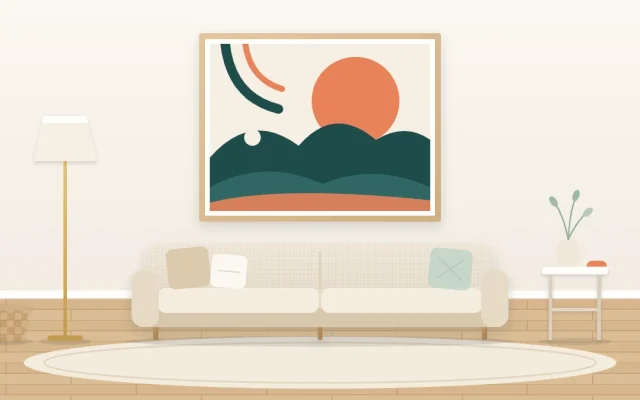
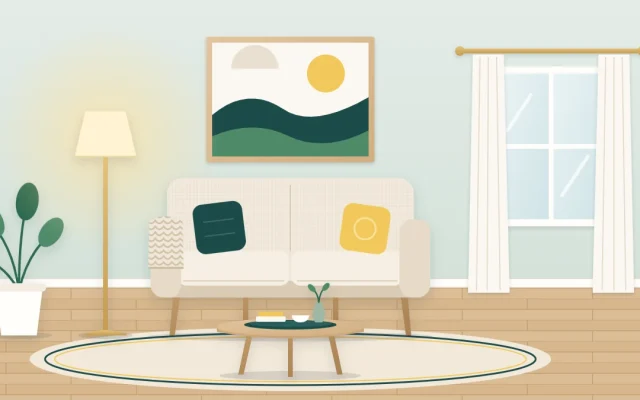
The eye reads a rug as the edge of the seating area. When the rug is a little island under the coffee table, the “room” appears to be that island, and the sofa and chairs look as if they are standing outside it.
A rug that reaches under the furniture does the opposite. It joins the pieces into one group and draws a larger shape on the floor, so the seating area, and the room around it, reads as more generous.
Three placements compared
There are three common ways to position a living room rug. Which one suits you depends on the room and on how the furniture sits in it.
| Placement | What it looks like | When it suits |
|---|---|---|
| All legs on | Every piece of seating sits fully on the rug | Seating that floats away from the walls, or an open room where the rug marks the living area |
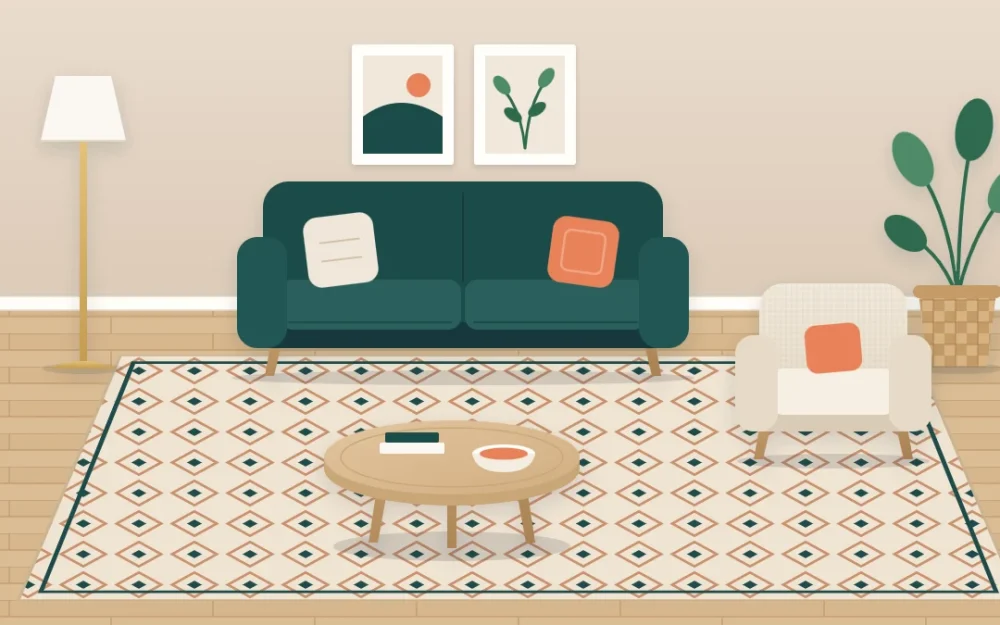
| Front legs on | The front legs of the sofa and chairs rest on the rug; back legs stay on the floor | Most small living rooms, especially with the sofa against a wall |
| Coffee table only | A small rug sits under the table, touching no seating | A last resort, when a larger rug truly cannot fit or you are making do with one you own |
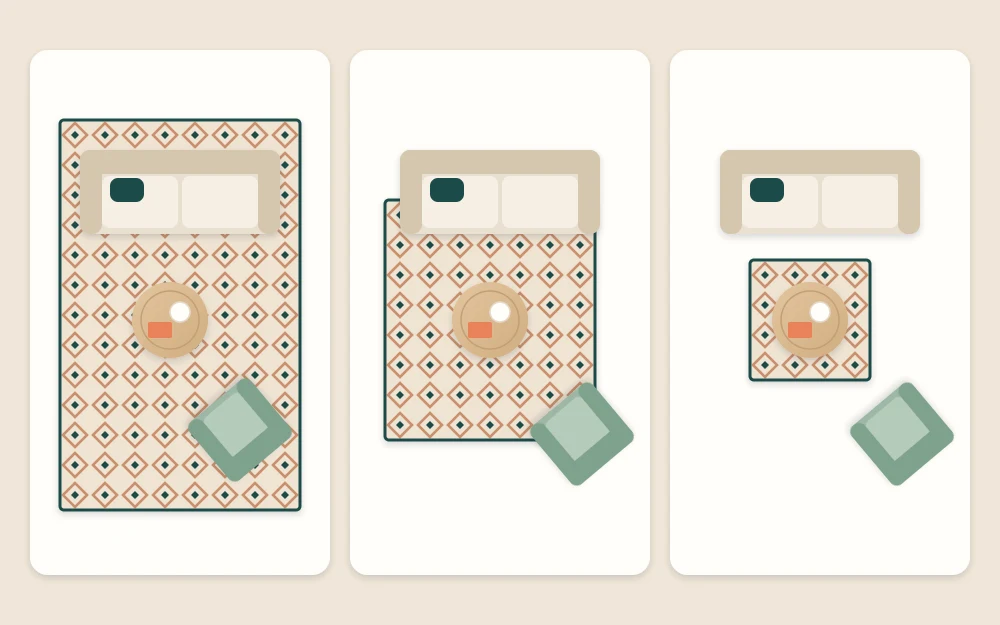
Front legs on is the usual answer for a compact room. The rug needs to slide only about 6 to 8 in (15 to 20 cm) under the front of each piece to look intentional, so you get the joined-up effect without a rug that fills the whole floor. If your living area shares one open space with a kitchen or dining table, all legs on can work harder, as the piece on decorating an open-plan small apartment explains.
Leave a border of bare floor
A rug that runs wall to wall starts to look like poorly fitted carpet. A margin of visible floor around it frames the rug and keeps the room feeling light.
As a rule of thumb, roughly 8 to 18 in (20 to 45 cm) of bare floor between the rug and the walls works in most living rooms. In a very small room the lower end of that range, or a little less, is fine. Try to keep the border fairly even on the sides you can see, and let the rug extend a little past each end of the sofa if the room allows.
Measure and mark it out
Do this with the furniture already where you want it. If the layout is still undecided, settle that first using the ideas in furniture placement for tight rooms, because the rug follows the seating and not the other way around.
- Measure the width of the sofa and the full width of the seating group, including any chair.
- Decide on a placement from the table above.
- Lay painter’s tape on the floor where the rug edges would fall: under the front legs, past the ends of the sofa and in front of the coffee table.
- Check the border to each wall, and make sure the tape does not cross a doorway or the main walking path awkwardly.
- Measure the taped rectangle. That is your target size.
- Compare it with the sizes on sale and re-tape the nearest one, to see whether going slightly larger or smaller looks better.
- Leave the tape down for a day and look at it from the doorway and from the sofa.
Common sizes, as examples only
Rug sizes vary between makers, so treat these names as rough reference points and always check the listed dimensions.
- About 4 by 6 ft (120 by 180 cm): usually ends up as a coffee-table-only rug in a living room; better beside a bed or in an entry.
- About 5 by 8 ft (150 by 240 cm): often suits a two-seat sofa with front legs on.
- About 6 by 9 ft (180 by 270 cm): a frequent fit for a three-seat sofa and a chair in a small room.
- About 8 by 10 ft (240 by 300 cm): can take all legs on in a compact room, if the border still works.
When your taped outline falls between two sizes, the larger one is usually the better choice, provided some floor still shows around it.
Shape, pattern and pile
Rectangle or round
A rectangle follows the lines of a sofa and suits most layouts. A round rug works well under a round table with a pair of chairs, or in a square room where a rectangle would feel forced. It still needs to be large enough for the front legs to reach it.
Pattern scale
Very small, busy patterns can look fussy across a large rug, and a huge motif may be cut off by the furniture. A medium-scale pattern, a simple stripe or a textured plain is the easiest to live with. To see how the rug fits with the rest of the room, browse the collection of small living room decor ideas.
Pile height near doors
If the rug will lie within the swing of a door, check the gap under the door before choosing a thick pile. Flat-woven and low-pile rugs slide under most doors more easily, and chair legs move over them without catching.
Add a rug pad that suits your floor
A non-slip pad keeps the rug from creeping and its corners from curling, which matters most with light, flat-woven rugs on smooth floors. Choose a pad described as suitable for your floor type, whether that is wood, laminate, vinyl or tile, since some pad materials do not agree with some floor finishes.
Buy the pad slightly smaller than the rug, or trim it, so that it sits a little inside the edge on every side and stays out of sight. Follow the pad maker’s care guidance, and lift the rug now and then to air the floor underneath.
Frequently asked questions
Is a 5 by 8 rug too small for a living room?
Not always. With a two-seat sofa in a compact room, a rug around that size can sit under the front legs and look right. With a longer sofa plus a chair it often falls short. Tape the listed dimensions on your floor to see whether the seating reaches it.
Should a rug go under the sofa?
In most small living rooms, yes, at least partly. Sliding the rug a short way under the front legs links the sofa to the rest of the seating and stops the rug from drifting. Having the whole sofa on the rug is optional and mainly suits layouts where the seating stands away from the walls.
Can I use a round rug in a small living room?
You can, particularly in a square room or with a curved sofa or round coffee table. Choose a diameter wide enough for the front legs of the seating to rest on it. A round rug that floats in the middle touching nothing has the same shrinking effect as a small rectangle.