Curtains for a Small Apartment: Length, Color and Hanging Height
Where to place the rod, how long the fabric should fall, which weight suits your light and how to pick a color, plus honest options when drilling is not possible.
At a glance
- Difficulty
- Easy
- Time
- About 30 to 60 minutes to measure and plan
- Best for
- Living rooms and bedrooms with one main window
- Renter note
- A rod needs wall fixings: choose them for your wall type and ask before drilling
What you need
- Tape measure
- Pencil
- Step stool
- Painter's tape or pins
- An old bedsheet for a mock-up
- Notepad
A window is often the largest single feature in a compact room, so the way you dress it changes how the whole wall reads. Choosing curtains for a small apartment comes down to five decisions: where the rod sits, how long the fabric falls, how much light it lets through, what color it is and how full it hangs.
Take those decisions in that order. Position and length do most of the visual work and are the hardest to change afterward, while color and fabric are easy to adjust once the proportions are right.
Step 1: Place the rod higher and wider than the frame
A rod fixed right on top of the window frame draws a line at frame height and stops the eye there. Raise it and the fabric becomes one long vertical shape, which helps the wall read as taller. A common starting point is roughly 4 to 6 in (10 to 15 cm) above the frame. Where there is a lot of wall above the window, about halfway between the frame and the ceiling often looks better still.
Width matters just as much. Let the rod run past the frame by about 6 to 10 in (15 to 25 cm) on each side, so the open curtains stack against the wall instead of over the glass. The window looks wider, and you keep every bit of daylight.
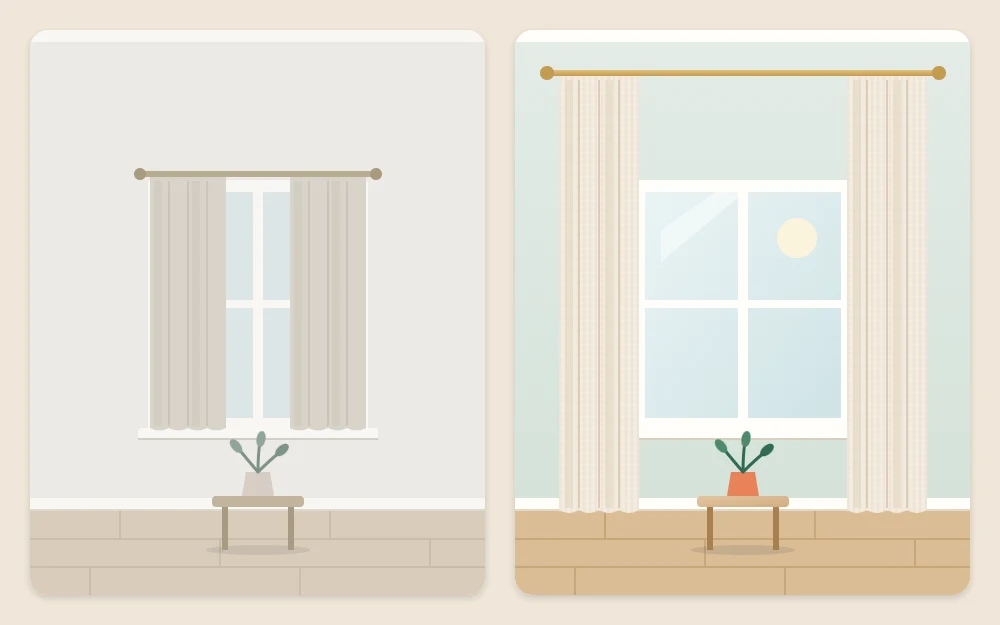
Curtains hung this way are one of several ways to draw the eye up and use the height of a room, and they work especially well next to low furniture.
Step 2: Decide on the length
Floor length
For most living rooms and bedrooms, fabric that just touches the floor, or hovers a finger-width above it, gives the cleanest line. Curtains that stop a hand-width short look like they shrank, and fabric that pools on the floor collects dust and takes up visual space a small room cannot spare.
Sill length
Shorter curtains are the practical choice in a few situations: a radiator or heater under the window, a desk, sofa or bed pushed against that wall, or a kitchen window above a counter. In those spots, end the fabric just below the sill so it looks deliberate. Keep curtains clear of any heat source and follow the heater maker’s guidance on clearance.
Step 3: Match the fabric to the light you need
Weight decides how the curtain hangs and how the room feels at noon and at night. The three common types compare like this.
| Fabric | What it does | Where it suits |
|---|---|---|
| Sheer | Softens daylight and blurs the view in, with little privacy after dark | Rooms that are not overlooked, or layered behind a heavier pair |
| Light-filtering | Glows in daylight and gives reasonable privacy | Living rooms and most everyday windows |
| Lined | Blocks more light, hangs in heavier folds and feels warmer | Bedrooms and street-facing windows |
In a small room, light-filtering linen or cotton blends are an easy default because they look relaxed and do not form a dark block when closed. If you need darkness to sleep, a lined pair in a pale color keeps the wall light while still doing the job.
Step 4: Choose a color
There are two honest routes, and both work.
- Close to the wall color. Curtains a shade or two away from the wall almost disappear, so the wall stays calm and continuous. This suits rooms that already have plenty going on.
- Contrast as a feature. A deeper color or a simple stripe turns the window into the main event. It works best when the rest of the room is quiet and the color already appears somewhere else, such as a cushion or a print.
If you are unsure which accent to repeat, settle your overall color palette first and pull the curtain color from it. Large-scale patterns can overwhelm a short wall, so keep patterns small or tonal.
Step 5: Get the fullness right
Skimpy panels are the detail that most often makes curtains look unfinished. As a rule of thumb, the combined width of the panels should be about one and a half to two times the width of the window, so the fabric still falls in soft folds when it is closed. Sheers can take even more.
Tip
Before buying, pin or tape a bedsheet at the planned rod height and width. Step back to the doorway and check that the length and the stack at each side look right.
If you cannot drill
Start with what is already there. Many apartments have an existing track or rod that only needs better fabric, and new curtains on old hardware are often enough.
A tension rod is the usual no-drill option. It presses between the two sides of a window recess, so it can only sit inside the frame. That means you give up the higher-and-wider placement, and it is best kept for sheers and light fabrics within the limits its maker states. Pressure pads can also leave marks on some paint, so check the spot after a few days.
Curtains are among the easiest things to pack up and rehang, which is why they appear in most lists of decor you can take with you.
Before you hang anything
If you do mount a rod, choose the fixings for your wall type and for the combined weight of the rod and fabric, and follow the manufacturer’s instructions. In a rental, check your lease or ask before making changes.
Measure before you shop
- Mark the planned rod height lightly in pencil, then measure from that mark to the floor or to just below the sill.
- Measure the window width and add the extra you want on each side to get the rod length.
- Multiply the window width by one and a half to two to find the total panel width.
- Note how the curtain attaches, since rings, tabs and rod pockets each change where the top of the fabric sits.
Write the three numbers down and take them with you. Ready-made panels come in a limited set of lengths, so when you fall between two, the longer one hung slightly higher usually looks better than the shorter one hung low.
Frequently asked questions
How high should curtains hang in a small apartment?
A common starting point is a rod roughly 4 to 6 inches above the window frame, or about halfway between the frame and the ceiling when there is more wall to work with. The aim is one long vertical line of fabric, so adjust until the proportions look right from the doorway.
Should curtains touch the floor in a small room?
In most living rooms and bedrooms, yes: fabric that just meets the floor looks tidy and helps the wall read as taller. Sill length makes more sense above a radiator, a counter or furniture pushed against the window wall, where long fabric would bunch up or get in the way.
Can a tension rod replace a regular curtain rod?
Only partly. A tension rod sits inside the window recess, so the curtains cannot be set higher or wider than the frame, and it suits sheers and light fabrics within the limits its maker gives. It is a reasonable choice for a small or secondary window when drilling is not possible.