Temporary Wall Decor: Removable Wallpaper, Decals and Other Reversible Ideas
Six reversible ways to bring pattern and color to a rental wall, compared in one table, with the surface preparation and test patch to do before you commit to any stick-on product.
At a glance
- Difficulty
- Intermediate
- Time
- About 1 to 2 hours for one panel, after a test patch of a few days
- Best for
- Smooth, sound walls behind a bed, console or desk
- Renter note
- Results depend on the paint and surface: test in a hidden spot, follow the manufacturer's instructions and ask before making changes
What you need
- Tape measure
- Level
- Pencil
- Soft cloth
- Smoothing tool
- Sharp craft blade and straight edge
- A small piece of the product for a test patch
Pattern on a wall changes a room faster than almost anything else, and it is also the change renters feel least free to make. Temporary wall decor fills that gap: treatments that sit on or in front of the wall for as long as you live there and are meant to come away when you leave.
“Meant to” is the honest phrase. How any stick-on product behaves depends on the wall underneath it, so this guide compares six options side by side and then walks through the preparation and test patch that should come before you commit. Check your lease or ask before making changes.
Six reversible options compared
The first four touch the wall. The last two only rest against it, which makes them the lowest-risk way to get a large effect.
| Option | Effect | Effort | What it suits |
|---|---|---|---|
| Peel-and-stick wallpaper on one panel | Strong pattern or color, like a feature wall | Moderate; careful measuring, easier with two people | Smooth walls behind a bed, console or desk |
| Wall decals | Scattered shapes or a loose repeat | Low; place one at a time | Small areas, entries, a child’s corner |
| Decorative paper tape | Fine lines, frames or simple geometric shapes | Low to moderate; needs a level eye | Outlining a headboard shape or a frame around art |
| Large fabric hanging | Soft color and texture over a wide area | Low once a rod or rail is in place | Behind a bed or sofa, textured walls |
| Freestanding painted board or screen | A block of solid color, exactly the shade you want | Moderate; painting done off the wall | Any wall, including textured or freshly painted ones |
| Leaning oversized art | One bold focal point | Very low | Above a console, on the floor in a corner |
How to choose for your wall
Begin with the surface. Run your palm across the wall. If it is smooth and the paint feels sound, all six options are open to you, subject to a test. If it is textured, bumpy or the paint is flaking or very fresh, skip the stick-on products and go straight to fabric, a leaned board or large art.
Then decide how much pattern the room can take. In a small space one treated area is usually plenty, and it works best on the wall you already look at: behind the bed, behind the sofa or opposite the door. Keep the colors inside the scheme you already have, and if you have not settled one yet, the guide to choosing a small apartment color palette is the place to start.
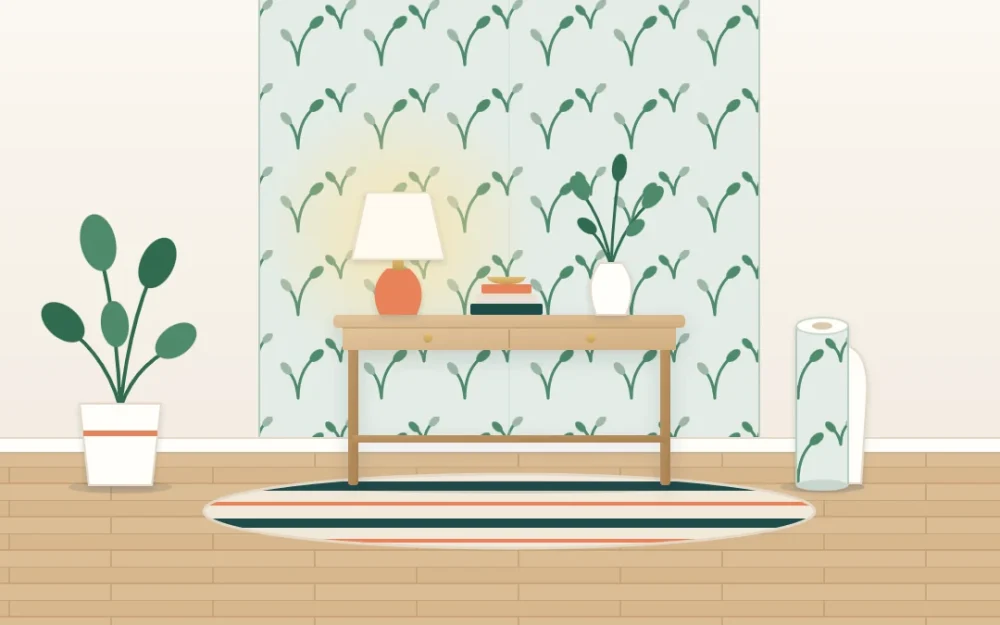
A single panel is often better than a whole wall. A strip of paper the width of a console, running from the baseboard to the ceiling, frames the furniture below it and uses a fraction of the material.
Prepare the surface
Adhesive products need a clean, dry wall. Dust and kitchen grease stop them from gripping evenly, and damp areas such as the wall beside a shower are a poor match for most of them.
- Wipe the area with a barely damp cloth and let it dry fully.
- Check the product’s instructions for how long new paint should cure before anything is applied.
- Note any hairline cracks, patches or glossy repairs, since the paint there may behave differently from the rest.
Run a test patch first
Paint finishes and wall surfaces vary from one apartment to the next, and even from one wall to another in the same room. The type of paint, its age, the texture and how well it bonded when it was applied all affect what happens when an adhesive is pulled away. Nothing can be promised in advance, which is why a test is worth the wait.
- Choose a hidden spot on the same wall if possible: low down behind where furniture will stand, or inside a closet with the same paint.
- Apply a small piece of the actual product, pressing it down as directed.
- Leave it for a few days, through at least one warm afternoon and one cool night.
- Remove it slowly, following the manufacturer’s instructions for removal, and look closely at the paint.
Good to know
A good test result is encouraging, but it describes a small piece over a few days. A full panel left up for a year or two may not behave identically, so keep to the manufacturer’s guidance on use and removal throughout.
Apply one panel of removable wallpaper
If the test went well, a single panel is a manageable first project.
- Mark the edges. Use a level and light pencil marks to draw a true vertical line for the first strip. Walls and corners are rarely perfectly straight.
- Cut with spare length. Leave a little extra at the top and bottom, roughly 2 in (5 cm) as a starting point, to trim later.
- Peel a little at a time. Pull back the top section of the backing, align the strip to your line and smooth downward from the center outward.
- Match the pattern. Line up the second strip against the first before pressing it down.
- Trim. Run a sharp blade along a straight edge at the ceiling and baseboard.
Ideas that never stick to the paint
A tall board painted in your chosen color and leaned behind a console gives the look of a painted panel with nothing applied to the wall. Thin plywood or a large stretched canvas both work. Stand it where it cannot tip, behind furniture that holds its base in place.
A fabric hanging covers the widest area with the least fuss: a length of printed cotton, a woven blanket or a flat-woven rug. It does need a rod or rail, and any fixing should be chosen for the wall type, the weight of the textile and the manufacturer’s instructions.
Oversized art resting on the floor or a cabinet is the simplest of all. For more ways to fill a blank wall, including mirrors and shelves, see these wall decor ideas for small apartments.
Taking it down
Keep the product instructions, or a note of where to find them, for the day you move. Remove slowly and at the angle the maker describes, working in small sections instead of pulling a whole strip at once. If any section resists, stop and reread the guidance before continuing.
Wall treatments are only one part of making a rental feel personal. Rugs, lamps and furniture carry just as much, and the wider approach is laid out in the guide to decor you can take with you.
Frequently asked questions
Will removable wallpaper come off my rental wall without problems?
It is not possible to say in advance. The outcome depends on the paint type, its age, the wall texture and how well the paint bonded. Apply a small piece in a hidden spot, leave it for a few days and remove it as the manufacturer directs before deciding whether to go ahead.
What can I use on a textured wall?
Stick-on products generally need a smooth surface to grip evenly, so textured walls are better served by things that stand or lean. A freestanding painted board, a folding screen, a large fabric hanging on a rod or an oversized artwork resting on a console all give a strong effect.
Is one panel of wallpaper enough for a small room?
Often it is the better choice. A strip the width of the furniture below it, running from baseboard to ceiling, frames a bed or console and gives the eye a clear place to rest. It also means less measuring and less material than covering a full wall.