Bedroom Office Combo: Decorating a Multi-Purpose Room That Still Feels Restful
Follow one small bedroom as it gains a desk without losing its calm: where the desk goes, how to separate work from rest, and how to close the office away each evening.
A bedroom office combo asks one small room to do two opposite jobs: keep you alert at ten in the morning and let you switch off at ten at night. Fitting a desk in is rarely the hard part. The decorating challenge is making sure the desk stops asking for attention once the workday ends.
The clearest way to see how that works is to follow one room from start to finish. The example here is a compact bedroom with a window on the short wall, a door on the opposite side and a bed against one long wall. Your room will differ, but the order of the decisions carries over.
Start with the view from the pillow
Before moving anything, lie down where your head normally rests and look around. Whatever sits in that view is what your evening feels like. A screen, a stack of paper and a tangle of chargers in direct sight keep work in the room long after you have stopped doing it.
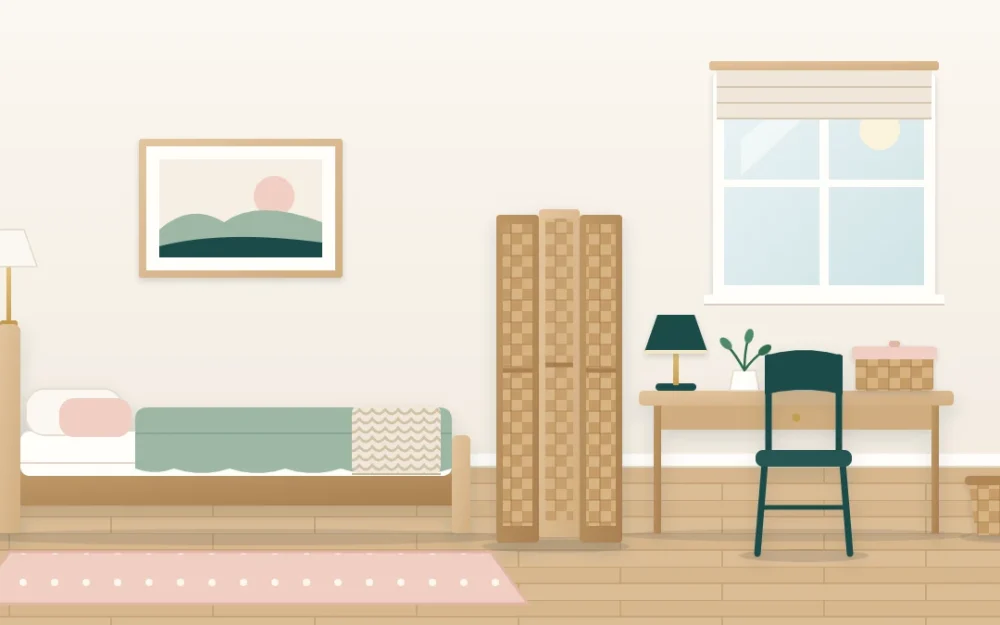
In the example room, the desk goes beside the window at the foot end of the bed, turned so the chair faces the window wall. From the pillow you see the narrow side of the desk and the back of a chair, not the work surface.
If your room offers different walls, these positions usually keep the desk out of the resting view:
- Beside the bed, level with the headboard. The desk sits behind your shoulder when you lie down and can double as a nightstand.
- At the foot end, facing away. You see the back of the chair, which is easy to make attractive.
- In an alcove or beside a wardrobe. The side of the furniture hides the desk from most of the room.
Put a visual break between work and rest
Once the desk has a position, give the two halves of the room a soft border. It does not need to block anything. It only needs to tell the eye that one area ends and another begins.
The example room uses two breaks together. A small flat-woven rug sits under the desk and chair, separate from the runner beside the bed, so the floor itself marks a work zone. Then a three-panel folding screen stands partly between the desk and the mattress, covering the monitor from the pillow while leaving the window clear.
Other breaks that suit a tight bedroom:
- A light curtain on a tension rod across an alcove, drawn in the evening.
- The side of an open bookcase standing at a right angle to the wall, with the shelves facing the desk.
- A change of art style: one calm piece above the bed, a small pinboard or framed print above the desk.
For any tall freestanding piece, follow the maker’s guidance on securing it, and keep screens where they cannot be knocked over in the dark. The same dividing ideas scale up to a whole one-room home, which the guide to zoning a studio apartment without walls covers in detail.
Choose a desk that passes for something else
A desk that looks like office furniture turns the bedroom into an office with a bed in it. A desk that could be a console or a dressing table does the reverse. Look for a slim top on plain legs, with no keyboard tray, cable ports or shiny black surfaces.
A depth of roughly 18 to 24 in (45 to 60 cm) is a common starting point for a laptop setup, and a shallower top leaves more floor showing. In the example, the desk is pale wood to match the bed frame, and the chair is an upholstered dining chair in the same sand tone as the bedding. Nothing about the pair says “work” when the laptop is gone.
Tip
Lean a small mirror against the wall at the back of the desk. During the day it bounces window light onto the work surface. In the evening it turns the cleared desk into a dressing table.
Close work away at the end of the day
The single most effective habit in a shared room is a closing routine, and the decor can make it effortless. Give work one container with a lid, sized to hold everything that normally lives on the desk. A lidded box in woven fiber or covered fabric reads as a bedroom object, and there are more good-looking options in the guide to baskets, boxes and trays chosen as decor.
- Shut the laptop and place it in the box with the charger, notebook and pens.
- Put the lid on and slide the box to the back corner of the desk or onto a shelf.
- Tuck the chair fully in and turn off the desk lamp.
- Leave only the “after hours” items on the surface: a small plant, a dish, the mirror.
One palette, two lamps
Keep both halves of the room in the same colors. Desk accessories are a common place for a stray bright red folder or a neon pen pot, and in a small room those shout. Choose the box, the desk mat and the lamp from the tones already used on the bed. The full approach to bedding, headboards and bedside surfaces is in the guide to styling a compact bedroom.
Light is where the two zones should differ. The desk gets an adjustable plug-in lamp aimed at the work surface. The bed gets a low, shaded lamp with a warmer bulb. Turning one off and the other on becomes the signal that the room has changed jobs.
The same thinking in other shared rooms
A living-dining room
Apply the pillow test from the sofa. Place the table so its clutter is not the main view, give it its own rug or a low lamp, and clear it down to one bowl or vase after meals so it reads as a console.
A guest corner
A daybed or sofa bed in a work room follows the same order. Keep guest bedding in a lidded basket, use a cushion arrangement that makes the bed read as seating, and add one small lamp a guest can reach from the pillow.
A quick check before you call it done
- From the pillow, can you see a screen or loose paper? If so, shift the break or the desk angle.
- Does every work item fit in one closed container?
- Do the desk and bed share at least two colors or materials?
- Can you light the bed without lighting the desk?
Frequently asked questions
Where should a desk go in a small bedroom?
Choose a spot you do not look at from the pillow. Beside the bed at headboard level, at the foot end facing away, or tucked next to a wardrobe all keep the work surface out of your resting view. Side light from a window is more comfortable than a window directly behind the screen.
How do I separate a work area from the bed without building anything?
Use a soft border rather than a barrier. A small rug under the desk and chair, a folding screen, a light curtain on a tension rod or the side of an open bookcase each mark where work ends. Even a different style of art above each area helps the two zones read as distinct.
What kind of desk looks least like an office in a bedroom?
A slim table on plain legs in the same wood or color as the other bedroom furniture, paired with a dining or accent chair instead of a typical task chair. Once the laptop is put away it can pass for a console or dressing table, especially with a small mirror and a plant on top.