Small Apartment Bedroom Decor: Styling a Compact Bedroom
Style a bedroom that is barely larger than the bed: a headboard or headboard effect, bedding layered in two or three tones, slim stand-ins for nightstands, plug-in reading lights and a quiet palette.
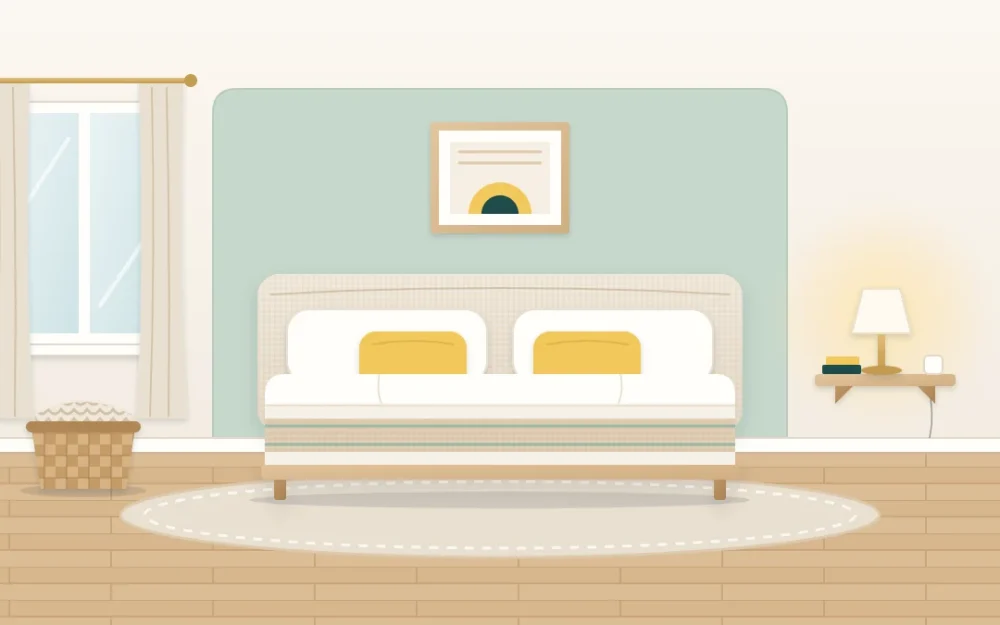
When a bedroom is barely larger than the bed, there is no layout to solve. The bed goes where it fits, and that is that. What is left is styling, and good small apartment bedroom decor comes from accepting one fact: the bed is most of the room, so the bed is the decor.
That makes the job simpler than it sounds. Dress the bed and the wall behind it well, replace bulky bedside furniture with slimmer stand-ins, keep the colors quiet, and the room looks calm and finished with very few objects in it.
Make the bed the focal point
In a compact bedroom the eye lands on the bed whether you plan for it or not. Work with that. Where the room allows, center the bed on the wall you see from the door, so the first view is symmetrical: bed in the middle, something slim on each side.
If the bed has to sit in a corner, treat the long wall side like the back of a daybed, with a row of pillows along it, and put your effort into the wall at the head.
Give the bed a headboard, or the effect of one
A headboard finishes a bed the way a frame finishes a picture. A simple one in wood, cane or plain upholstered fabric is enough; avoid deep, bulky designs that push the bed farther into the room.
With no headboard, the wall can do the same work:
- One wide artwork centered above the pillows, about two-thirds the width of the bed as a loose guide.
- A textile such as a woven hanging or a quilt on a slim rod, which adds softness as well as a shape.
- A painted panel the width of the bed, in a soft color a few shades deeper than the walls, rising to roughly 48 in (120 cm) or carried higher to draw the eye up. Check your lease or ask before painting.
- A row of large pillows propped upright against the wall, the simplest version of all.
Pick one. A panel plus art plus a textile competes with the bedding and crowds the wall.
Before you hang anything
Anything fixed above a bed should be secure and light. Choose hardware for your wall type and the weight of the piece, follow the manufacturer instructions, and get help if you are unsure. A textile or a canvas without glass is a comfortable choice for this spot, and a large frame leaned on a shelf elsewhere in the room avoids fixings altogether.
Layer the bedding in two or three tones
Bedding covers more surface than anything else in the room, so it sets the palette. A reliable recipe uses three layers in two or three related tones:
- A light base. Sheets and duvet cover in white, cream or a pale neutral keep a small room bright.
- A middle tone. A quilt or blanket folded across the lower third of the bed, a shade or two deeper than the base.
- A small accent. Two pillows or one long cushion in the strongest color in the room.
Keep the pillow count modest: sleeping pillows plus two accents is plenty on a bed that fills the room. To stop a neutral bed from looking flat, vary the materials instead of adding colors; the layering approach is laid out in the guide to mixing textures in a small bedroom.
Swap nightstands for something slimmer
Standard nightstands are often the piece that makes a small bedroom feel jammed. All you really need beside the bed is a surface for a glass, a book and a phone.
- A small wall shelf set about level with the top of the mattress. It keeps the floor clear, which helps the room read as more open.
- A stool or a stack of large books. Movable, and easy to tuck in when you make the bed.
- A slim ledge above the headboard running the width of the bed. It serves both sleepers and doubles as a place for a small print.
- A narrow shelf on one side only when the bed sits against a wall.
Matching the two sides, even with something as small as two identical shelves, gives the bed wall a settled, symmetrical look.
Bring reading light off the surface
A table lamp takes up most of a tiny bedside shelf. Lifting the light onto the wall or the headboard frees the surface and looks tidier.
Two plug-in options do this well: a wall lamp with an adjustable arm, fixed beside the bed with its cord running straight down inside a cord cover, and a clamp lamp attached to the headboard or the shelf edge. Aim for a warm bulb and a shade that hides the bulb from your eyes when you are lying down. The same wall-type, weight and instructions check applies to a wall lamp as to art. Lights wired into the wall are a job for a licensed electrician, with the landlord’s permission in a rental. More choices are in the guide to layered lighting with plug-in lamps.
Curtains and rugs: the soft edges
Curtains are the second-largest textile in the room. Choosing a color close to the wall keeps the room calm, and hanging them high and full gives it height; the measurements are in the guide to curtain length, color and hanging height.
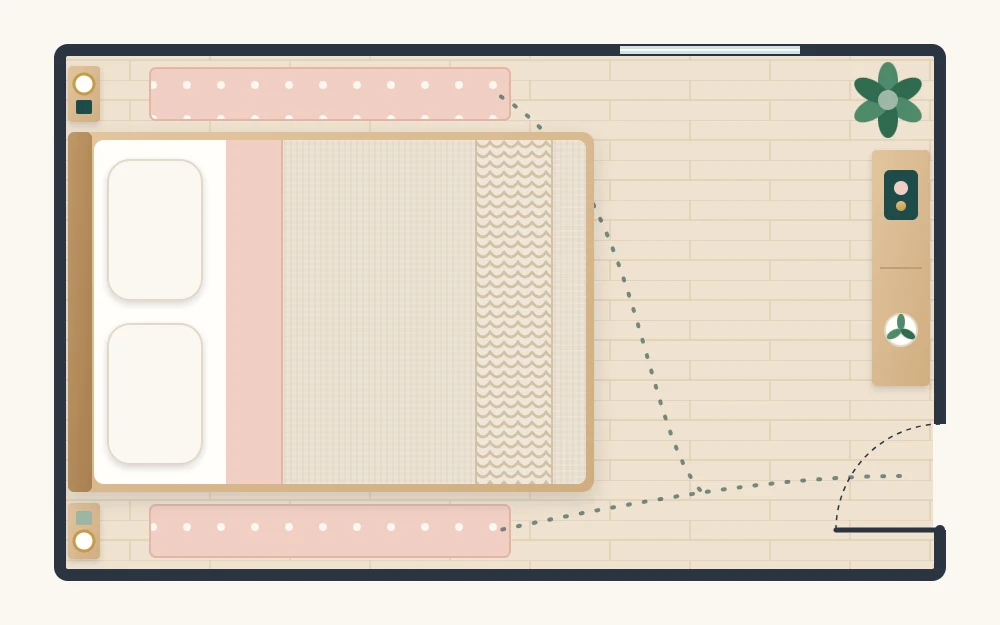
On the floor, choose one of two approaches. One rug placed under the lower two-thirds of the bed, showing about 18 in (45 cm) on each side as a rough starting point, unifies the room. Where the bed nearly touches the walls, two narrow runners, one per side, give you something soft to step onto and use far less rug.
Keep the palette quiet and the surfaces nearly clear
A bedroom this size has room for about three colors: the base, one supporting neutral and one accent. Repeat the accent two or three times, in the pillows, the art and perhaps a small vase, and leave it there.
Then edit the surfaces. Each one gets a lamp or a single object, plus whatever you use every night. The dresser top holds a tray and one plant or frame, not a collection. Clothes, chargers and paperwork go behind doors or into a lidded box. If the room must also hold a desk, the bedroom and office combination guide shows how to keep work from taking over the view from the bed.
Frequently asked questions
How do I decorate a bedroom that only fits a bed?
Treat the bed as the decoration. Give it a simple headboard or a headboard effect on the wall, layer the bedding in two or three related tones, and replace nightstands with small wall shelves or a stool. Keep everything else, including curtains and rug, close to the wall color.
What can I use instead of nightstands in a small bedroom?
A small wall shelf at mattress height, a stool, a sturdy stack of large books or a slim ledge running above the headboard all hold a glass, a book and a phone. Pair any of them with a plug-in wall lamp or a clamp lamp so the surface stays free.
What colors work in a very small bedroom?
A quiet palette of about three colors tends to feel restful: a light base for walls and bedding, one supporting neutral such as sand or soft gray, and one accent repeated two or three times. Deeper colors can work well in small amounts, for example on a panel behind the bed.