Small Apartment Entryway Ideas: Creating an Entry Where There Is None
Build an entry on one short strip of wall from four elements: hooks, a landing surface, a mirror and a mat. Includes placement steps, a comparison of slim surfaces and finishing touches.
At a glance
- Difficulty
- Easy
- Time
- About 1 to 2 hours once you have the pieces
- Best for
- Front doors that open straight into the living room or a narrow hall
- Renter note
- Needs wall fixings for hooks, shelf and mirror: choose them for your wall type and ask before drilling
What you need
- Tape measure
- Painter's tape
- Pencil and small level
- Peg rail or hooks
- Slim shelf or narrow console
- Mirror
- Flat mat or runner with a non-slip pad
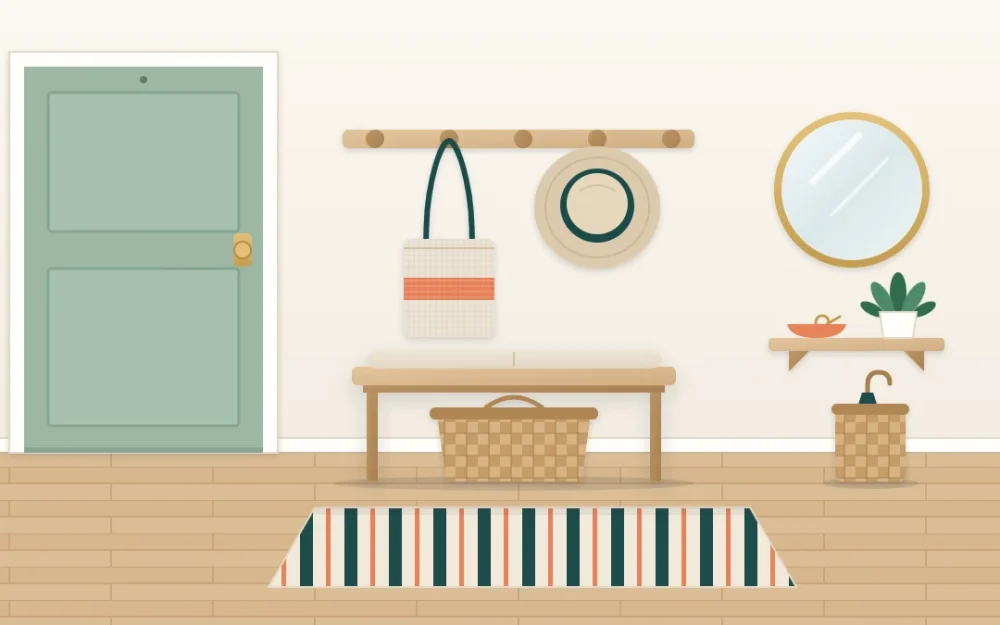
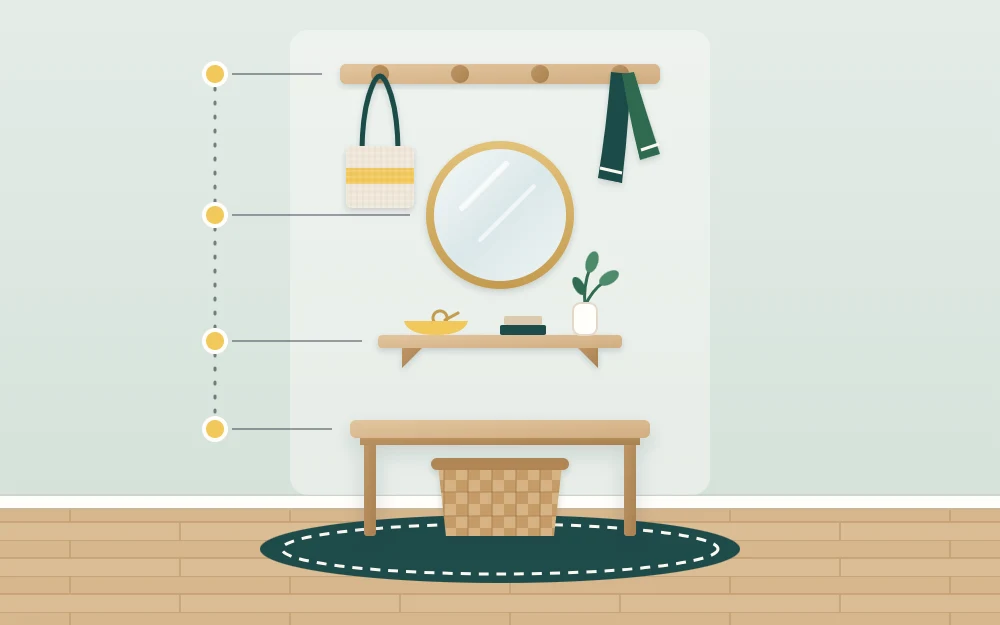
Many apartments have no entry at all. The front door opens straight onto the sofa, or into a hall barely wider than the door itself, and coats, keys and shoes end up wherever they land. The best small apartment entryway ideas do not depend on having a hallway. They depend on four simple elements arranged on one short stretch of wall.
Put those four together and the patch of floor inside the door starts to behave like a room of its own: a place to arrive, put things down and check the mirror on the way out. It also gives the rest of the apartment a tidier first impression.
The four elements of an entry
- Something to hang on: a row of hooks or a peg rail.
- A landing surface: a slim shelf or a narrow console for keys and mail.
- A mirror: for a last look, and to bounce light around a dim spot.
- A floor marker: a small durable mat or runner that says “the entry is here”.
Stacked vertically, all four fit on a strip of wall about 24 to 30 in (60 to 75 cm) wide, which is a common starting point for the narrowest setups.
Find your strip of wall
- Open the front door fully and mark where its edge stops with painter’s tape on the floor. Nothing in the entry should sit inside that arc.
- Look at the wall on the handle side of the door first. It is the easiest to reach as you walk in.
- If that wall is taken, try the wall facing the door, the side of a wardrobe or bookcase, or the back of a sofa that stands near the door.
- Tape the outline of the shelf, mirror and hooks on the wall and live with it for a day, checking that coats on the hooks will not brush your shoulder as you pass.
Element 1: hooks or a peg rail
A peg rail looks calmer than scattered single hooks because it reads as one object. Three to five pegs are plenty; an entry is for the coat and bag in current use, not the whole wardrobe.
A common starting height is roughly 60 to 66 in (150 to 165 cm) from the floor, adjusted so long coats clear the bench below. Treat what hangs there as part of the decor: one good tote, a hat and a scarf look styled, while six jackets look like storage.
Before you hang anything
For hooks, rails, shelves and mirrors that are fixed to the wall, choose hardware for your wall type and the weight of what it will carry, and follow the manufacturer instructions. Check your lease or ask before making changes, and get help with anything heavy if you are unsure. Adhesive hooks suit light items only, such as keys or a hat. Paint finishes and surfaces vary, so test one in a hidden spot first and follow the manufacturer directions for use and removal.
Element 2: a landing surface
Keys, mail and sunglasses need one fixed home. The right piece depends on how much depth you can spare.
| Surface | Depth it needs | Suits |
|---|---|---|
| Slim wall shelf or picture ledge | About 4 to 6 in (10 to 15 cm) | Narrow halls and doors that open against the wall |
| Narrow console table | About 10 to 12 in (25 to 30 cm) | A free wall beside or facing the door |
| Top of a low shoe cabinet | Depends on the cabinet | Entries that also need closed storage |
| Back of a sofa with a slim table behind it | The width of the table | Doors that open straight into the living room |
Whatever you choose, put a tray or a shallow dish on it. A dish turns loose keys and coins into a single tidy object and stops the surface from spreading into a dumping ground.
Element 3: a mirror
Hang the mirror above the landing surface, with its center near eye level, so shelf and mirror read as one composition. A round mirror softens all the straight lines of a doorway; a tall narrow one suits a strip of wall too slim for anything else. A full-length mirror leaned securely against the wall is an alternative when you would rather not fix anything.
Check what the mirror reflects before you settle on a position. A window or a lamp is ideal; the coat hooks are not. More on choosing positions is in the guide to placing mirrors in a small apartment.
Element 4: a floor marker
A mat or runner draws the edge of the entry on the floor, which matters most when the door opens into the living room. Choose a flat, durable weave that the door can swing over, in a color or stripe that relates to the main rug nearby.
Add a non-slip pad suited to your floor type so the mat stays put.
Add a seat, a basket and one finishing touch
With the four elements in place, three extras make the entry feel intended.
- A stool or slim bench. Somewhere to sit while tying shoes. A bench about 12 in (30 cm) deep is enough, and a stool tucks under a console.
- A basket for shoes. One basket under the bench hides the pairs in daily use. Woven or lidded containers that look good in plain sight are covered in the guide to baskets, boxes and trays as decor.
- One piece of art or a lamp. A small framed print beside the mirror, or a little rechargeable or plug-in lamp on the console, signals that this is a decorated spot and gives you a warm light to come home to.
Tip
Keep the entry in the same colors as the room it opens into. Repeating the living room accent in the mat or the key dish makes the entry look planned as part of the whole apartment.
Keeping it looking good
An entry collects things faster than any other spot. Give it a limit: one coat and one bag per person on the hooks, only today’s shoes in the basket, only keys and mail in the dish. Everything else goes back to the closet once a week.
If this is the first corner of the apartment you have finished, it is a good model for the rest. The same order, function first and then one or two finishing touches, runs through the beginner’s guide to decorating a small apartment.
Frequently asked questions
How do I create an entryway when the door opens into the living room?
Claim the strip of wall on the handle side of the door, or use the back of the sofa as a boundary with a slim table behind it. Add hooks, a small surface for keys, a mirror and a mat on the floor. The mat is what tells the eye where the entry ends and the living room begins.
What is the smallest setup that still works as an entry?
A peg rail, a shallow shelf with a key dish and a mat take up almost no floor at all and cover the three daily needs: hanging a coat, dropping keys and wiping shoes. Add a mirror above the shelf if the wall allows, and a stool only when the door swing leaves room for it.
How do I keep a small entry from looking cluttered?
Set a limit for each element: one coat and one bag per person on the hooks, a single dish on the shelf, one basket for shoes. Choose a peg rail over scattered hooks, keep containers in one material, and move everything that is not in daily use back to a closet.