Mirrors in a Small Apartment: Where to Place Them and Why
A mirror repeats light and whatever sits opposite it. Here is how to test a reflection first, the five positions that work best in compact rooms, what to keep out of the glass, and how to decide between leaning and hanging.
At a glance
- Difficulty
- Easy
- Time
- About 20 to 40 minutes, plus a day of living with the taped outline
- Best for
- Living rooms, hallways and entries that feel dim or closed in
- Renter note
- Leaning needs no fixings; for hanging, choose hardware for your wall type and the mirror's weight and ask before drilling
What you need
- Mirror
- Painter's tape
- Tape measure
- Pencil
- A second person to hold the mirror
- Hardware suited to your wall, if hanging
A mirror is one of the most useful pieces of decor in a compact home, but only when it has something worth repeating. Put on the wrong wall, it simply doubles the drying rack. Placed well, it carries daylight further into the room and gives the eye a second view to rest on.
That is the whole secret of mirrors in a small apartment: a mirror does not add space, it repeats light and whatever sits opposite it. So the question is never “where is there a free wall?” but “what will this glass show from where I usually sit or stand?”
What a mirror actually does
Three things, all of them visual. It bounces light from a window or lamp back into the room, so darker corners pick up some brightness. It repeats a view, which gives you two windows, two plants or two lamps. And it adds depth: the wall seems to open onto something beyond it, which helps a tight room read as more open.
The catch is that a mirror is neutral. It repeats a pile of mail as faithfully as it repeats a leafy plant. Every placement decision below comes back to that.
Test the reflection before you commit
Before anything goes on a wall, spend ten minutes checking what the mirror will show.
- Sit or stand where you spend the most time: the sofa, the bed, the spot just inside the front door.
- Ask someone to hold the mirror against the wall you have in mind. For a large one, lean it there instead, or hold up a smaller mirror at the same height.
- Look at what appears in the glass. Shift it a little left, right, up and down and watch how the view changes.
- Repeat in the evening with your lamps on. A reflection that is lovely at noon can turn into a glaring bulb at night.
- When you like what you see, mark the corners with painter’s tape and live with the outline for a day.
The best places for a mirror
Beside a window
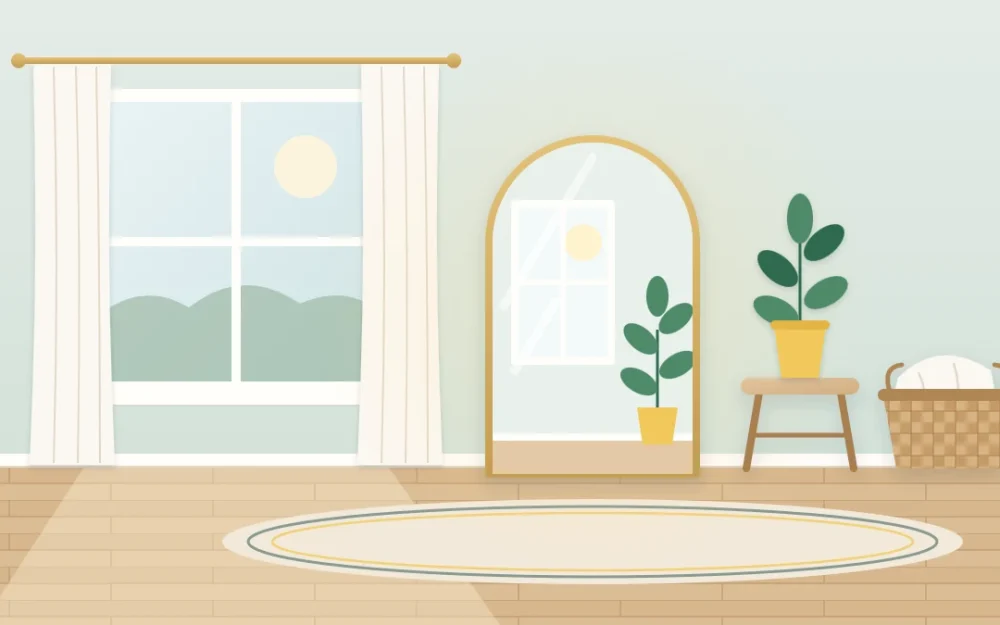
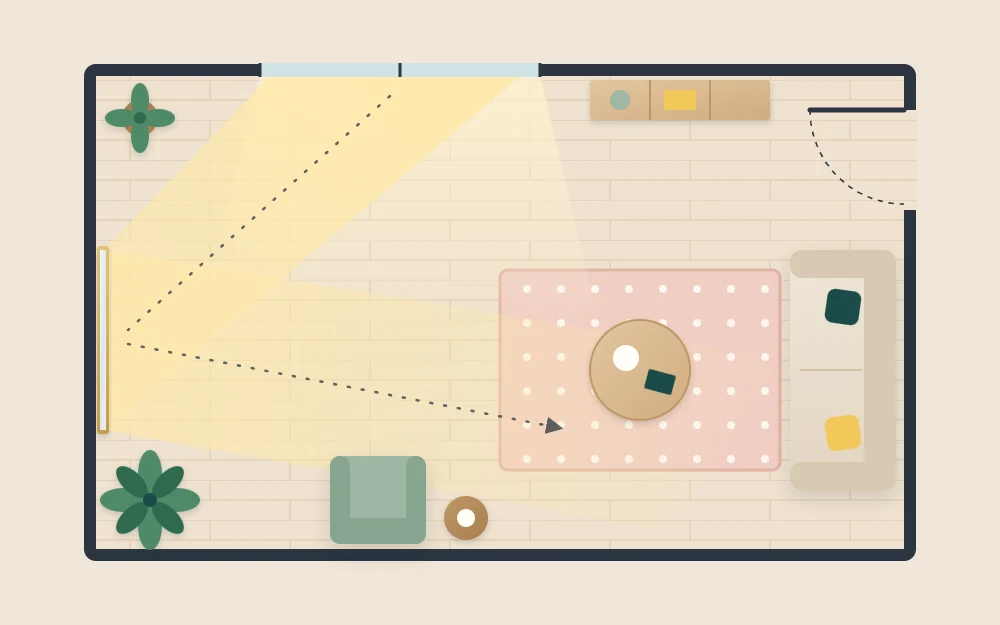
The wall next to a window, at a right angle to the glass, is often the strongest position. Daylight comes in, meets the mirror at an angle and travels deeper into the room, and the mirror catches a slice of sky or greenery without facing the window head-on.
Across from a window, slightly off-center
Directly opposite a window works when the view is pleasant. If it is a parking lot or a neighbor’s wall, slide the mirror along so it catches the window at an angle, or picks up a plant on the sill instead. Opposite a very sunny window, check for glare at the time of day you use the room.
At the end of a hallway
A narrow hall usually stops dead at a blank wall. A tall mirror there gives the corridor a sense of continuing and returns whatever light reaches it. Keep it flat to the wall so nothing sticks out into the walking path.
Above a console in the entry
A mirror over a slim console or shelf turns a strip of wall into an arrival point, and it is handy on the way out the door. A gap of roughly 6 to 8 in (15 to 20 cm) between the tabletop and the bottom of the frame is a common starting point, close enough that the two read as one group. The guide to creating an entry where there is none covers the rest of that wall.
Behind a lamp
Set a table lamp in front of a mirror on a console, dresser or shelf, and the glow is doubled after dark. A shaded lamp works best, because the mirror repeats a bare bulb as sharply as everything else. For more on spreading light around a room, see these layered lighting ideas with plug-in lamps.
What not to reflect
- Clutter. An open closet, a busy kitchen counter or a loaded coat rack becomes twice as loud.
- The television. A large dark rectangle is rarely what you want more of, and a moving screen in a mirror is distracting.
- A blank door. A mirror facing a plain door or an empty stretch of wall adds nothing; it only repeats the blank.
- A bare ceiling bulb. If the glass catches it from where you sit, lower the mirror or move it sideways.
If the only free wall faces one of these, give that wall a different kind of decor and put the mirror elsewhere.
Choosing size and shape
One generous mirror usually does more than several small ones, which chop a reflection into fragments. Above furniture, a mirror about two-thirds the width of the piece below it is a comfortable rule of thumb. On a wall with nothing beneath, placing the center near eye level is the usual starting point.
Shape changes the mood. A round mirror softens a room full of rectangles. An arched or tall narrow mirror draws the eye upward and suits a slim wall. A wide horizontal one stretches a short wall. Pick a frame in a material that already appears in the room, such as wood, black metal or a brass tone, so the mirror belongs to the palette. If a mirror turns out not to suit the wall, there are other wall decor ideas for blank walls to try.
Leaning a floor mirror or hanging one
A full-length mirror leaned against the wall needs no holes and moves with you. Stand it on a firm, level floor rather than on the edge of a rug, keep the lean shallow, and place it out of the walking path and clear of any door swing. Many floor mirrors come with a way to fasten the top to the wall; follow the maker’s guidance on securing it, especially in a home with children or pets.
Hanging keeps the floor clear and lets you set the exact height. Use the hanging points the mirror came with, and choose hardware for your wall type and the weight of the mirror, following the manufacturer’s instructions for both.
Before you hang anything
Mirrors are heavier than they look. If yours is large, or you are unsure what your wall is made of, get help rather than guessing. In a rental, check your lease or ask before making changes.
Frequently asked questions
Should a mirror face a window?
It can, if the view outside is one you would enjoy seeing twice. Often the wall beside the window is the better choice, because the mirror picks up daylight at an angle and pushes it further into the room without glare. Check the reflection at different times of day before you decide.
What size mirror suits a small room?
Larger than most people expect. One generous mirror gives a calm, unbroken reflection, while a cluster of small ones can look busy. Above a console or dresser, about two-thirds of the furniture's width is a useful rule of thumb. On a narrow wall, a tall slim mirror usually sits more comfortably than a wide one.
Is it fine to lean a mirror instead of hanging it?
Yes, leaning is a relaxed look that suits full-length and large mirrors and avoids holes in the wall. Stand it on a level floor, away from doors and walking paths, with a shallow lean. If the mirror includes a way to secure the top, follow the maker's guidance, particularly around children and pets.