Small Apartment Decorating for Beginners: Where to Start
A calm, five-step order for decorating a small apartment: read the room, pick a short color list, place the big pieces, add rug, curtains and lamps, then finish the walls.
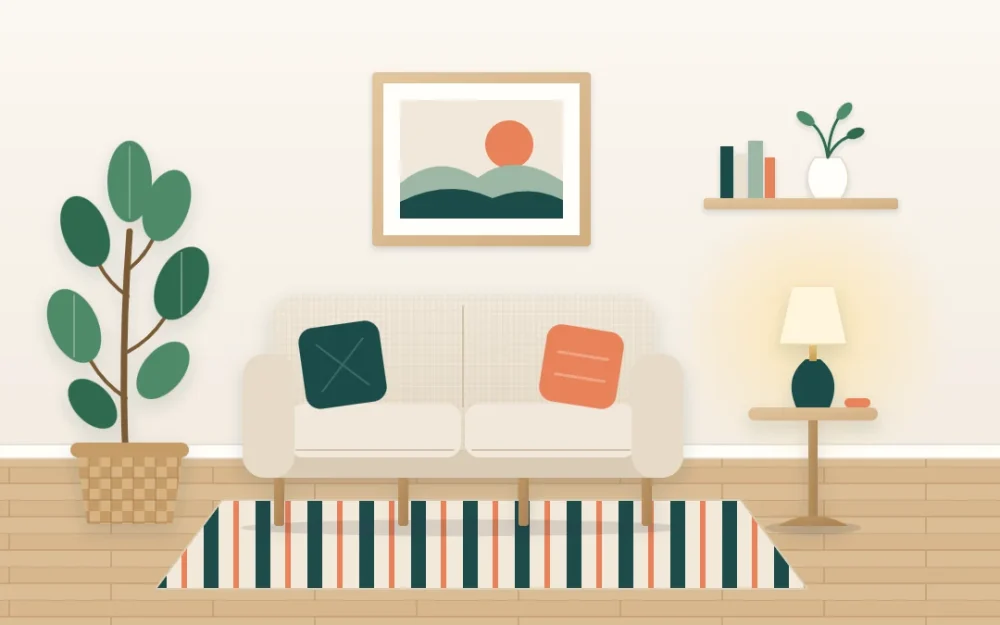
The hardest part of small apartment decorating is rarely the lack of space. It is the lack of an order. Everything seems to need deciding at once: the sofa, the wall color you cannot change, the rug, the bare window, the box of frames in the corner.
A sequence solves most of that. Work from the largest, slowest decisions to the smallest, quickest ones, and each step narrows the choices in the next. The order below suits a first apartment, a new rental, or a room you want to start over without replacing everything in it.
Step 1: Read the room before you add to it
Give yourself a day or two of plain looking. Stand in the doorway in the morning and again in the evening, and note three things.
- The light. Which window gives the most daylight, and where does the room go dim after sunset? Bright spots suit seating and plants; dim corners are where lamps will go later.
- The paths. Trace how you really walk: door to sofa, sofa to kitchen, bed to closet. Those lines need to stay open, so nothing large belongs on them.
- The first wall. One wall meets your eye as you come in. Whatever sits on or against it sets the tone for the whole room, so it deserves your best piece.
Write these down, along with the things you cannot change: the floor, the counters, the fixed blinds. They are part of the design whether you chose them or not.
Step 2: Settle on a short list of colors
A compact home shows nearly all of its colors at a glance, so a short list works harder than a long one. Pick one light base that covers most surfaces, one or two quiet neutrals for furniture and textiles, and one or two accents you enjoy seeing every day.
Start from what is already there. If the floor is a warm honey wood, a base with a little warmth will sit more easily beside it than a cool, bluish white. The guide to building a color palette for a small apartment walks through undertones, proportions and how to carry the same colors from room to room.
Keep the list where you can see it while you shop, as fabric scraps, paint cards or a note on your phone. It turns “do I like this?” into the easier question “does this belong?”
Step 3: Place the big pieces
The sofa, bed, table and any tall storage go in next, because everything else depends on where they land. Begin with the largest piece and the wall or corner that suits it, then fit the others around the walking paths you traced in step 1.
Resist filling every wall. A room with one fewer piece of furniture and a clear route through it usually feels more comfortable than a room that seats one extra person. For the reasoning behind where pieces go, and a way to test a layout with tape on the floor first, see the concepts in furniture placement for tight rooms.
Step 4: Add the rug, the curtains and the lamps
These three do more for a finished look than any accessory, and they are easier to choose once the furniture is in place.
- Rug: large enough to connect the seating, in a color drawn from your list. It marks the living area as one group instead of several stray pieces.
- Curtains: long, simple panels in a fabric close to the wall color keep a small room calm and soften the hard edges of the window.
- Lamps: two or three plug-in lamps at different heights, so the evening light comes from the sides of the room and not only from overhead.
Live with this layer for a week before going further. A room with furniture, a rug, curtains and good lamp light is already most of the way there, and it shows you clearly which walls and surfaces still feel empty.
Step 5: Finish with walls and small objects
Art, mirrors, cushions, plants and the objects on shelves come last. Chosen early, they tend to be too small, too many and in colors that fight the rest. Chosen now, they have a job: fill the wall that feels bare, repeat an accent, add something leafy to a stiff corner.
Start with the first wall from step 1 and give it one generous piece. Then add slowly, a few things at a time, and stop when the room feels settled. For specific ideas at this stage, the collection of decor ideas for a small living room is a good next read.
Before you hang anything
Check your lease or ask before making changes to walls. Choose hardware to suit your wall type and the weight of the piece, and follow the manufacturer instructions. If a piece is heavy and you are unsure, get help, or lean it on a console or the floor instead.
Three ideas that keep a small room calm
Whatever your taste, three principles run underneath every step.
Scale
Small rooms do not need small things. Several undersized pieces read as clutter, while a few properly sized ones read as calm. One good-sized rug, one substantial lamp and one large artwork often suit a compact room better than a scatter of little ones.
Breathing room
Empty space is part of the design. Leave some floor visible, leave one wall plain, and leave part of each shelf and tabletop clear. The gaps let the things you love stand out.
Repetition
Let each accent color appear at least three times around the room: a cushion, a vase, a stripe in the rug. Repeat a material in the same way, such as light wood or woven fiber. The eye links the repeats, and the room reads as planned.
Go slowly, and check your work
There is no need to finish in a weekend. A room built in layers over a few months usually looks more personal than one bought in a single trip, because each addition answers something you noticed while living there.
When something feels off and you cannot name it, compare the room against the list of common small apartment decorating mistakes. Most problems come down to a handful of fixable causes, and spotting which one applies is quicker than starting again.
Tip
Take a picture of the room from the doorway after each step. A flat image shows crowding, bare patches and stray colors that are easy to miss when you are standing in the middle of them.
Frequently asked questions
What should I decorate first in a small apartment?
Begin with the room you spend the most waking time in, usually the living area. Within that room, settle the colors and the large furniture before anything decorative. Once the sofa, rug, curtains and lamps are right, the smaller choices become much easier and you are less likely to collect things that do not fit.
How many colors should a small apartment have?
A short list of roughly three to five works well as a starting point: one light base, one or two neutrals and one or two accents. Because you can see most of a compact home at once, repeating the same few colors in every room helps the whole place read as one connected space.
Do I need to buy new furniture to decorate a small apartment?
Not necessarily. Many rooms improve simply by removing one piece, moving the largest item to a better wall and clearing the walking paths. Work through the order with what you own first. Living with the result for a few weeks shows which single addition, such as a larger rug or a second lamp, would help most.