How to Create a Focal Point in a Small Living Room
Find the natural focal point in your living room or make one with art, a mirror, a rug or a lamp, then arrange the seating and quiet the rest of the room around it.
Stand in the doorway and notice where your eyes go. If they jump from the television to a shelf to a lamp to a stack of mail and never settle, the room has no focal point, and that restlessness is often what people mean when they say a space feels cluttered even though it is tidy.
Creating a focal point in a small living room is less about adding something and more about choosing. One element gets to be the star, and everything else agrees to play a supporting part. Here is how to find that element, or make one, and then arrange the room around it.
Why a small room needs exactly one
A focal point gives the eye a place to land first. Once it has landed, the rest of the room is read in relation to that spot, so the furniture looks arranged instead of merely placed.
Large rooms can carry two or three points of interest because there is distance between them. In a compact living room they all sit inside one glance and compete. Two bold things side by side cancel each other out, and the result reads as busy. One clear feature with calm surroundings is easier on the eye and helps the room feel more open.
Check for a natural focal point first
Some rooms already have one, and working with it is easier than fighting it. Look for these:
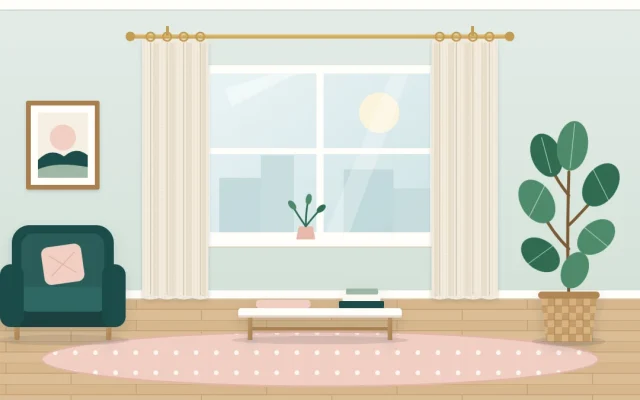
- A window with a decent view or good light. Frame it with simple curtains, keep the sill nearly clear and let the seating face or flank it.
- The wall you see first from the door. Whatever is on that wall sets the first impression, so it is the natural place for your strongest piece.
- An architectural feature. An alcove, a deep window recess or an old mantel already draws attention. Decorate it lightly and it will do the work.
Six ways to make one
When the room offers nothing obvious, build the feature yourself. Each of these suits a slightly different room.
A large artwork
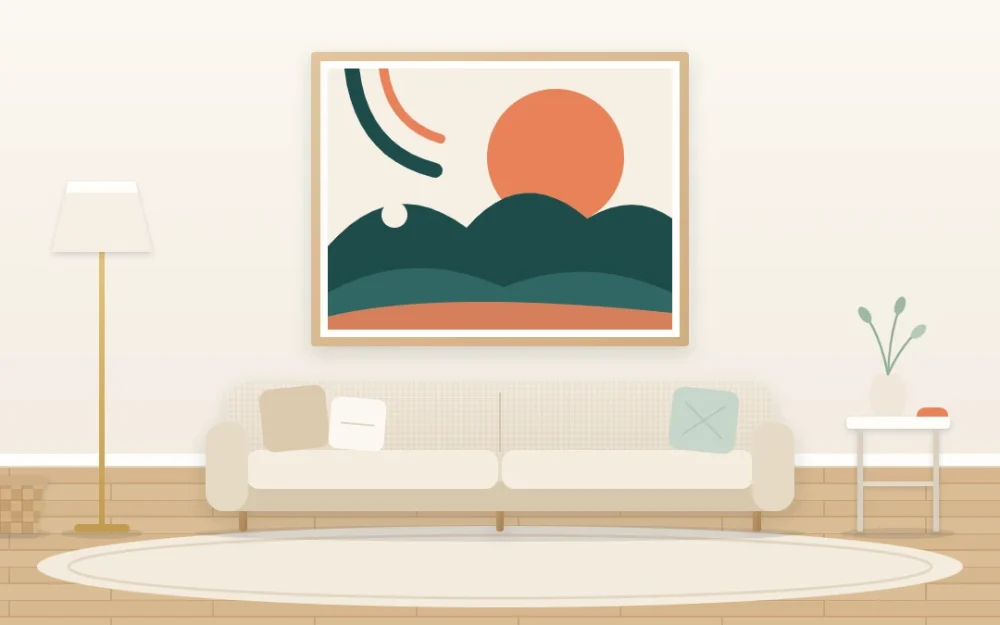
One generously sized piece above the sofa is the most dependable option. It should relate to the sofa in width instead of floating like a postage stamp; the guide on height, spacing and scale for art covers the proportions.
A mirror
A big round or arched mirror gives shape and brightness at once, as long as it reflects something worth seeing. Placement makes or breaks it, so read about where a mirror actually works before committing to a wall.
A styled shelf
A single shelf or a slim bookcase can be the feature if it is edited: a few larger objects, repeated colors and some empty space. A crowded shelf is background noise, not a focus.
A bold rug
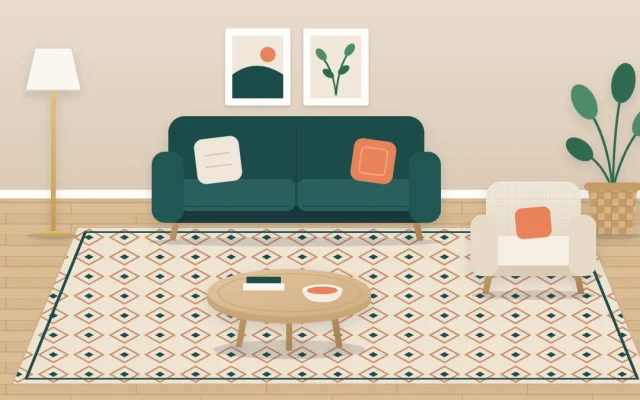
When the walls must stay plain, put the pattern on the floor. A rug with strong color or a clear geometric design anchors the seating, and the furniture on top should then be quiet and solid-colored.
A statement lamp
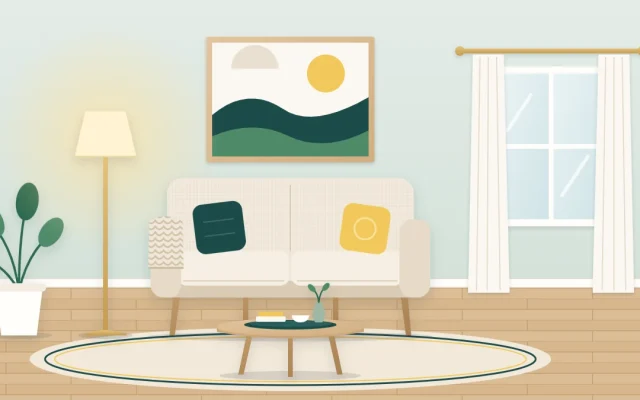
A floor lamp with a sculptural shape or an oversized shade works in a corner that would otherwise be dead. It has the advantage of being the brightest thing in the room at night, which is exactly when a focal point matters most.
A painted or papered panel
A block of deeper color or a panel of removable wallpaper behind the sofa frames everything in front of it. In a rental, check your lease or ask before making changes. Paint finishes and surfaces vary, so test removable paper in a hidden spot first and follow the manufacturer’s instructions for applying and removing it.
Before you hang anything
Choose hardware for your wall type and the weight of the piece, and follow the manufacturer’s instructions. A large mirror or heavy frame is a two-person job; get help if you are unsure. Leaning a big piece on a low cabinet is a good alternative.
Turn the seating toward it
A feature only works if the furniture acknowledges it. The sofa should face the focal wall or sit directly beneath the focal piece, and any chair should angle toward the same spot so the group forms a loose arc.
In practice, a small room usually allows two arrangements:
- Sofa under the feature. Art or a mirror hangs above the sofa, and you see the whole composition as you walk in. This suits rooms where the sofa wall faces the door.
- Sofa facing the feature. The sofa looks at a window, a styled shelf or a papered panel. This suits rooms where you spend more time sitting than passing through.
Center the coffee table and rug on the same line as the feature. When the middle of the rug, the table and the artwork line up, the arrangement looks intended.
Quiet everything around it
The feature can only stand out against calm. Go through the rest of the room and turn the volume down:
- Keep the walls beside and opposite the focal wall plain or nearly so.
- Repeat one or two colors from the feature in a cushion or a vase, and drop the colors that do not relate to it.
- Choose solid or softly textured fabrics near a patterned feature.
- Group small accessories on a tray so they read as one object.
- Aim a lamp at the feature in the evening so it stays the brightest point.
Tip
Squint at the room from the door. Whatever still stands out through half-closed eyes is the real focal point. If it is not the one you chose, tone that thing down or move it.
More supporting touches that stay in the background are collected in these small living room decor ideas.
When the television is the focus
In many small living rooms the only wall that fits the screen is the one the sofa faces, and there is no point pretending otherwise. Treat the television as part of a composition instead of a black rectangle alone on a white wall.
- Set it on a low, long cabinet that is clearly wider than the screen, so it sits within a shape.
- Darken the wall behind it, or lean a couple of dark-toned prints beside it, so the screen blends in when it is off.
- Balance it with something taller at one side, such as a plant or a floor lamp.
Then let the screen wall be the only feature. A large artwork on the opposite wall would set up a second focus, so keep what hangs behind the sofa modest and low in contrast.
Frequently asked questions
Can a small living room have two focal points?
It can, but it rarely works well. In a compact room both features fall within the same glance and compete for attention, which makes the space feel busier. Pick one as the main feature and tone the other down by lowering its contrast, shrinking it or moving it to another room.
What if the living room has no obvious focal point?
Then you get to choose one. The wall you see first from the door is usually the best candidate. Put your largest or most striking element there, such as a big artwork, a mirror or a well-edited shelf, and keep the neighboring walls plain so it stands out.
Should the sofa always face the focal point?
Not always. The sofa can either face the feature or sit directly beneath it, as it does when a large artwork hangs above. What matters is that the seating relates to it, with the rug and coffee table centered on the same line and any chair angled toward it.