Small Apartment Plants as Decor: Styling Greenery in Tight Spaces
How to use plants as shapes and color in a small apartment: seven placements that give floor space back, pots that suit your palette, the right scale, and what to do with dark corners.
A plant does something no cushion or print can do: it brings an irregular, living outline into a room full of straight edges. That is why small apartment plants earn their place even when every square foot is already spoken for. One good leafy shape softens a hard corner, adds a color that goes with almost everything, and gives the eye a place to rest.
The trick in a tight space is to treat greenery the way you would treat a lamp or a piece of art. You choose it for its shape, its height and its color, you decide where it goes before you bring it home, and you stop before the room turns into a windowsill jungle.
Read the plant as a shape first
Before thinking about species, think about silhouette. Most indoor plants fall into one of four outlines, and each does a different decorating job.
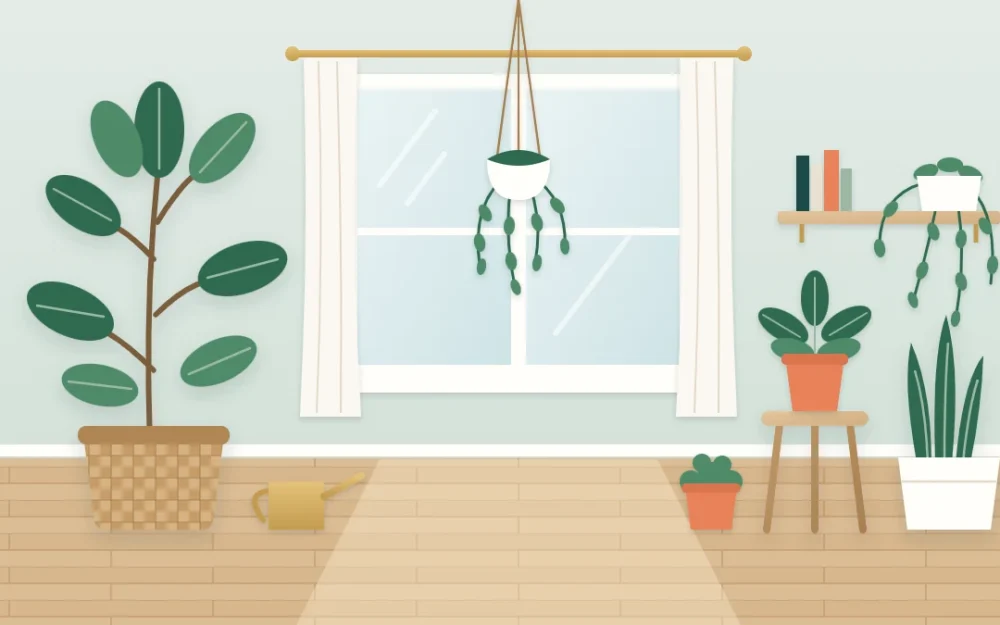
- Upright and tall: a strong vertical line that fills an empty corner and balances a low sofa.
- Trailing: stems that spill downward and soften the hard front edge of a shelf or cabinet.
- Rounded and bushy: a soft mound that sits well on a table or stool, where it reads as a single object.
- Spiky or sculptural: a graphic outline that works alone, like a small piece of sculpture.
A room with only one of these outlines looks flat. Two or three different silhouettes, repeated in the same few greens, look considered.
Five placements that give floor space back
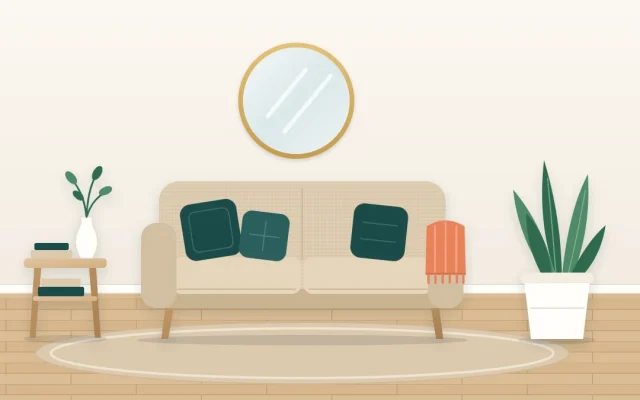
- One tall plant as a corner anchor. Put a single upright plant in the corner beside the sofa or the window. One large plant reads as calmer than five small ones and takes up about the footprint of a wastebasket.
- A trailer on the top shelf. Set a trailing plant near the end of a high shelf and let the stems fall past the shelf below. It links the shelves together and adds movement to a grid of books. The full method for the rest of the shelf is in the guide to arranging shelves as decor.
- A group of three at different heights. Cluster one tall, one medium and one low plant so their leaves overlap slightly. Keep the pots close enough to read as one arrangement, not three separate things.
- A stool as a plant stand. A small wooden stool lifts a medium plant to about sofa-arm height, which is where it is actually seen. The stool can go back to being a seat when guests arrive.
- A hanging planter near the window. Greenery at eye level or above uses air instead of floor and draws the eye upward, one of several ways to make a room read as taller.
Before you hang anything
A planter filled with damp soil is heavier than it looks. If you fix a hook to a ceiling or wall, choose the hardware for your wall type and the full weight of the pot, soil and water, follow the manufacturer instructions, and check your lease or ask before making changes. A plant on a tall stool or a freestanding stand gives a similar look with no fixings at all.
Choose pots that belong to the room
The pot is the part of the plant you control completely, so use it to tie the greenery into the rest of the apartment. Pick two materials at most, such as matte ceramic and woven fiber, and keep the colors inside the palette you already have: warm white, sand, terracotta, or one of your accent colors.
Matching every pot exactly can look stiff. A looser approach is to keep one thing constant and vary another: the same color in three different shapes, or the same shape in two related tones. A basket around a plain nursery pot adds texture; set a saucer inside it to catch water.
Match the scale to the furniture
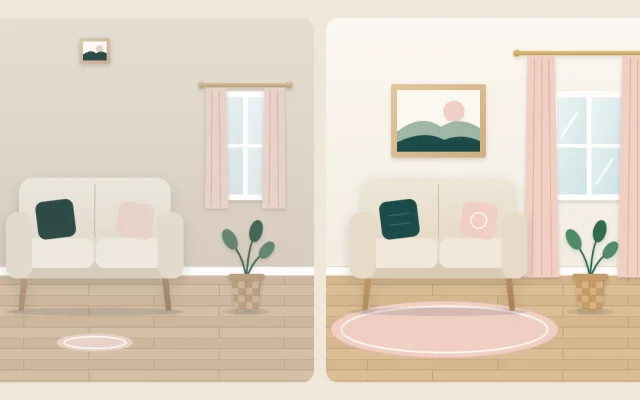
Scale is where plant styling usually goes wrong. A tiny pot on the floor next to a sofa disappears, and a huge plant beside a delicate side table overwhelms it.
- A floor plant beside seating looks balanced when its top sits somewhere above the sofa back, roughly 48 to 60 in (120 to 150 cm) tall including the pot, as a loose starting point.
- A tabletop plant looks right when it takes up no more than about a third of the surface, leaving room for a lamp or a book.
- On a shelf, leave a hand’s width of air above the leaves so the plant does not look jammed in.
Let the light make the decision
Light is the practical limit on every idea above. A plant placed purely for looks in a spot that is too dim will thin out, lean and drop leaves, and a struggling plant is worse decor than no plant.
So work the other way around. Stand in the spot at midday and notice what it really gets: direct sun on the leaves, bright light without direct sun, or only a dim glow from a window across the room. Then choose a plant whose label matches that description. The general background on houseplants explains why light needs differ so much from one plant to another.
Dark corners: artificial and dried stems
Some of the best-looking positions for greenery, such as a hallway shelf, the top of a wardrobe or a windowless bathroom, get almost no daylight. That is the place for good-quality artificial plants or dried stems.
A few things help them pass at a glance. Choose artificial stems with matte leaves and some variation in color, put them in a real pot with a layer of soil or pebbles on top, and bend the stems so they are not perfectly symmetrical. Dried grasses, seed heads and branches need no disguise at all; they bring height and texture in soft neutral tones. Both kinds also move with you easily, which makes them a natural part of decor you can take with you.
Keep the greenery looking intended
A short routine keeps plants working as decor. Remove yellow leaves when you see them, wipe dust from large leaves with a damp cloth, and turn pots a quarter turn now and then so growth stays even. When a trailing plant gets stringy, trim it back to the length that suits the shelf.
Finally, if pets or small children may chew leaves, check each plant’s safety with a reliable source before bringing it home, and place plants out of reach where there is any doubt.
Frequently asked questions
How many plants should a small apartment have?
There is no set number. A useful starting point is one larger plant per room plus one or two smaller ones, grouped so they read as a single arrangement. If surfaces start to feel crowded or the windowsill blocks daylight, remove a few and give the remaining plants more space around them.
Where should I put a plant when there is no floor space?
Look up and sideways. The end of a high shelf, the top of a cabinet, a windowsill, a stool that doubles as a seat, or a hanging planter near the window all hold greenery without using walking space. Check that the spot gets enough light for the plant you choose.
Do artificial plants look good as decor?
They can, especially in spots too dark for living plants. Look for matte leaves with uneven color, set the stems in a real pot topped with soil or pebbles, and bend them into a slightly irregular shape. Dried grasses and branches are another low-care choice that add height and soft texture.